

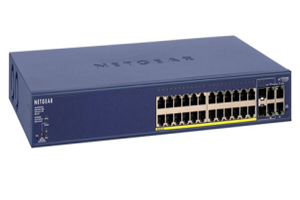
Network switch
Classification:Case
- Introduction
Detailed explanation of Netware FS728TP: specifications, features, functions and application scenarios.
NETGEAR FS728TP is a network switch, which is introduced by Netgear, a world-renowned network equipment manufacturer. As a part of enterprise-level network solution, the switch provides excellent performance, advanced security functions and reliable design, which meets the needs of enterprises for high-speed, stable and secure network connection.
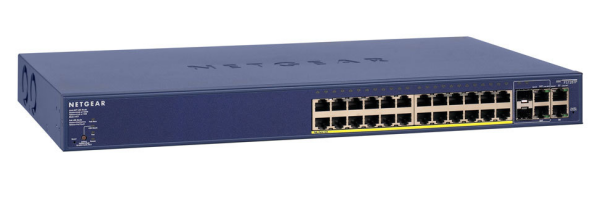
Netware FS728TP specification parameters
1. General specifications
Product model: Netware FS728TP
Equipment type: enterprise network switch
Rack size: 1U(1.75 inches)
Number of ports: 24 Gigabit Ethernet ports+4 SFP fiber ports
Total switching capacity: 56 Gbps
Forward rate: 41.7 Mbps (Ethernet)
2. Port characteristics
24 Gigabit Ethernet ports (supporting auto-negotiation speed and full duplex/half duplex mode)
4 SFP fiber ports (for fiber connection and long-distance transmission)
3. Exchange characteristics
Non-blocking switching: Yes
Forward mode: store-forward
VLAN support: 512 active VLANs
Switching matrix: 8K MAC address table
Static routing: support
Dynamic routing protocols: RIPv1/v2, OSPFv2
4. Safety features
802.1X network access control: Yes.
Access control list (ACL): support
Port security: Yes
DHCP Snooping: Yes.
IP/MAC binding: yes.
SSL and IPSec VPN support: yes
5, management characteristics
Management interface: Web interface, command line interface (CLI)
Remote management: SNMP v1/v2c/v3, RMON, Telnet, SSH.
System logs: local logs, remote Syslog servers
Firmware upgrade: Web interface, TFTP, FTP
6. Power supply and environment
Power supply: built-in power supply (AC input)
Power consumption: 30.6W max.
Operating temperature: 0 C to 50 C.
Storage temperature:-20 C to 70 C.
Operating humidity: 10% to 90% (non-condensing)
Features and functions of Netware FS728TP
1. Excellent performance: Netware FS728TP adopts high-performance hardware architecture and advanced switching technology, providing 24 Gigabit Ethernet ports and 4 SFP fiber ports, supporting line-speed forwarding and non-blocking switching, ensuring efficient data transmission and smooth network operation.
2. Advanced security: The switch provides a variety of advanced security functions to protect the enterprise network from potential security threats. Support 802.1X authentication and access control list (ACL) to limit unauthorized access and traffic; Provide VLAN and port security functions to isolate and manage network traffic; Support security protocols such as IPSec and SSL VPN, encrypt data transmission, and ensure data confidentiality and integrity.
3. High reliability design: Netware FS728TP adopts compact 1U rack design, which has good heat dissipation performance and low energy consumption. It supports redundant power supply and Link Aggregation (LACP), ensures the redundancy and load balance of the system, and improves the stability and reliability of the network. In addition, the switch also supports hot plug modules, which is convenient for maintenance and upgrade.
4. Easy to manage and deploy: Netware FS728TP provides an intuitive and easy-to-use management interface, supports Web interface and command line interface, and provides rich management options and real-time status monitoring. It is also compatible with standard management protocols such as SNMP and RMON, and is seamlessly integrated with other network management systems. This enables network administrators to easily configure, monitor and manage network devices, and simplifies network operation and maintenance.
5. Extensibility: The switch supports static routing and dynamic routing protocols, such as RIPv1/v2 and OSPF, to achieve more flexible network expansion and cross-segment communication. In addition, it also supports IPv6 protocol, which provides good support for future network upgrade and development.
Netware FS728TP application scenario
1. Small office network: As the core switch, it provides stable network connection and high-speed data transmission to meet the performance and reliability requirements of small office network.
2. Medium-sized and large-scale enterprise network: As a convergence layer switch, it connects networks of multiple departments or floors, provides a high-capacity and extensible network architecture, and supports large-scale data transmission and complex network topology.
3. Data center: As an access layer switch of servers and storage devices, it provides high-density port connection, low-latency and high-throughput data transmission, and meets the extremely high requirements of data centers for performance and reliability.